Somaliland Rock Art Beyond Laas Geel: Dhambalin, Karinhegane and More
Somaliland rock art is far richer than one famous site. Painted sheep at Dhambalin, cattle at Karinhegane and dozens of lesser-known shelters tell the story of the herders who lived here thousands of years ago.
HISTORY · ROCK ART
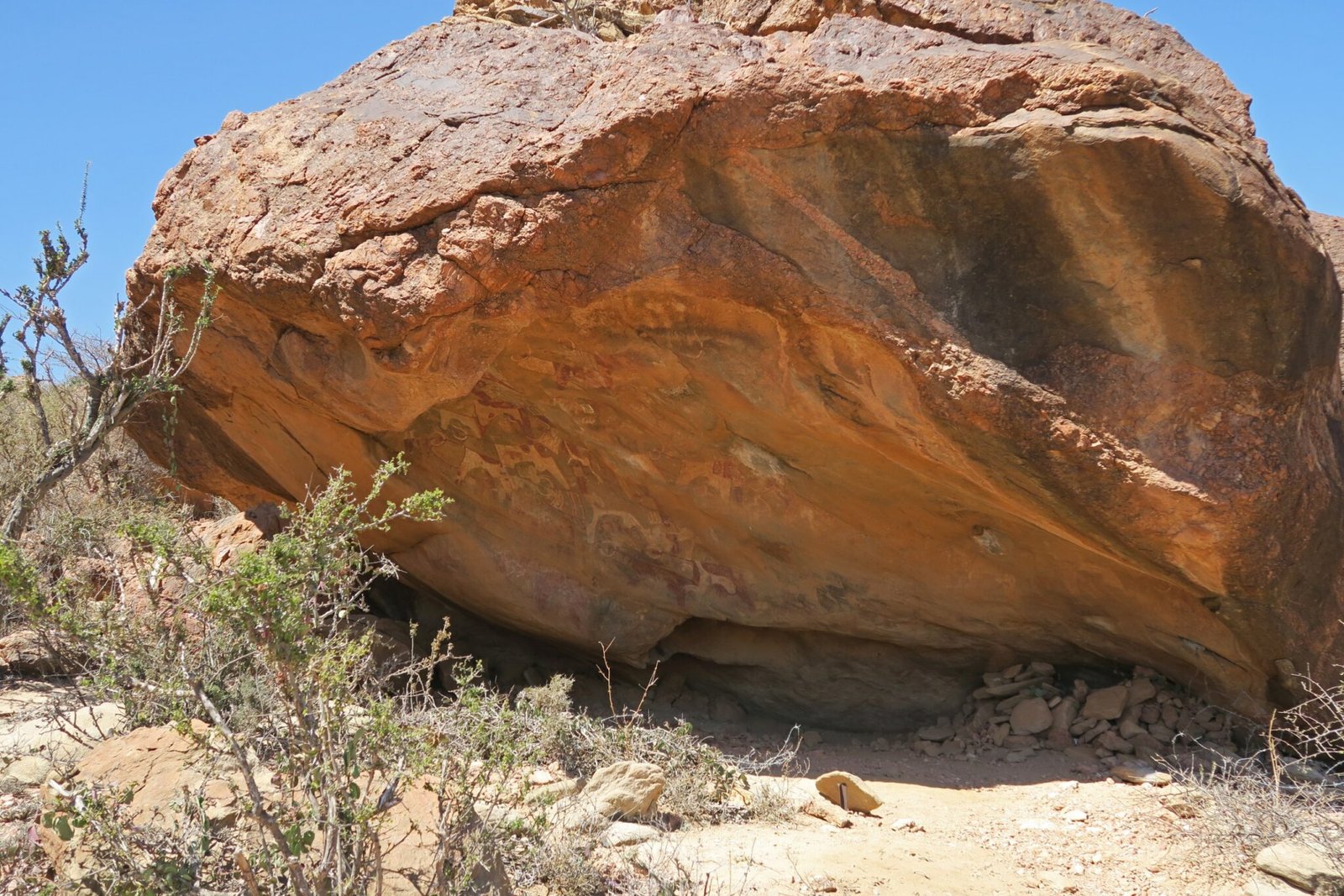
Most visitors know the painted shelters of Laas Geel, outside Hargeisa. Yet they are only one part of the picture. Researchers now know about 70 rock art sites in the region, according to the British Museum. One survey team reported almost 100. Here is what the less famous sites show, how old they may be, and why they need care.
Somaliland declared independence from Somalia in 1991 and governs itself. Somalia regards it as part of its territory. Israel (December 2025) is so far the only UN member state to recognise it (see Somaliland’s foreign relations).
Somaliland rock art at a glance
Here are the main documented sites beyond Laas Geel.
| Site | Region | What the paintings show |
|---|---|---|
| Dhambalin | Sahil | Cattle, sheep, goats, giraffes, dogs and hunters |
| Karinhegane (Karin Heegan) | Sanaag | Cattle, goats and human figures |
| Dhagah Kureh | Linked with Laas Geel | Large painted cows |
| Dhagah Nabi Galay | Linked with Laas Geel | Signs considered early writing |
| Dhaymoole | Sahil | White camels and symbols |
Dhambalin: the painted sheep of Sahil
Dhambalin is a sandstone rock shelter in the Sahil region, east of Berbera. Wikipedia translates its name as half, vertically cut mountain. Published distances from Berbera differ, from about 47 km to roughly 60 km.
The site came to light in autumn 2007. Residents of the nearby village of Beenyo Dhaadheer reported the paintings to the archaeologist Sada Mire. Mire described it as the first survey of its kind led by a Somali archaeologist in the region. She published the site in African Archaeological Review in 2008.
What makes Dhambalin special is its sheep. Mire called them the first sheep paintings in Somali archaeology. Wikipedia counts 14 identifiable sheep, without the black heads of today’s local breed. Around them are humpless cattle, some headless, plus antelopes, dogs, giraffes, snakes and a turtle. Human figures wear what look like headgear and carry bows and arrows.
The giraffes matter too. They no longer live in Somaliland, so the paintings record a different landscape. Bands painted across the cattle may point to farming or ritual practices. Mire also described a man on horseback as one of the earliest known depictions of a mounted huntsman, AFP reported. Wikipedia is more cautious: the rider may be on a horse or a similar animal.
Karinhegane: cattle and inscriptions in Sanaag
Far to the east, Karinhegane lies between Las Khorey and El Ayo in the Sanaag region. In 1947 an officer of the British Somaliland Government found the shelter, according to a 2012 review in the journal Adumatu. Researchers returned in the 1980s.
The shelter holds over one hundred polychrome paintings. They show long- and short-horned cattle, goats and human figures. The same review notes that Karinhegane has sheep paintings too, so Dhambalin is not the only shelter with them. Wikipedia adds that each painting has an inscription beneath it.
Dhagah Kureh, Dhagah Nabi Galay and other sites
Two sites are closely linked with Laas Geel. The name Dhagah Kureh translates as the stone with the head. Its shelters sit along a granite range of about 4 km, near farmland. According to CyArk, its first shelter has the largest number of large-cow panels in Somaliland. Dhagah Nabi Galay is considered to hold the first examples of writing in East Africa, though it has seen little research. Sources describe the two sites inconsistently, so treat the details with care.
Other shelters show later times. At Dhaymoole, the walls carry white camels, other animals and symbols. At Dawa’aleh, paintings about 2,000 years old show a full moon, a half-moon and geometric signs. Surveys in 2009 and 2010 added two new shelters, Sisib and Habajo, on the plateau.
How old is Somaliland rock art?
Paint is hard to date directly. So researchers compare styles, and look at which paintings were drawn over others. Mire noted that overlapping paintings may allow relative dating at Dhambalin.
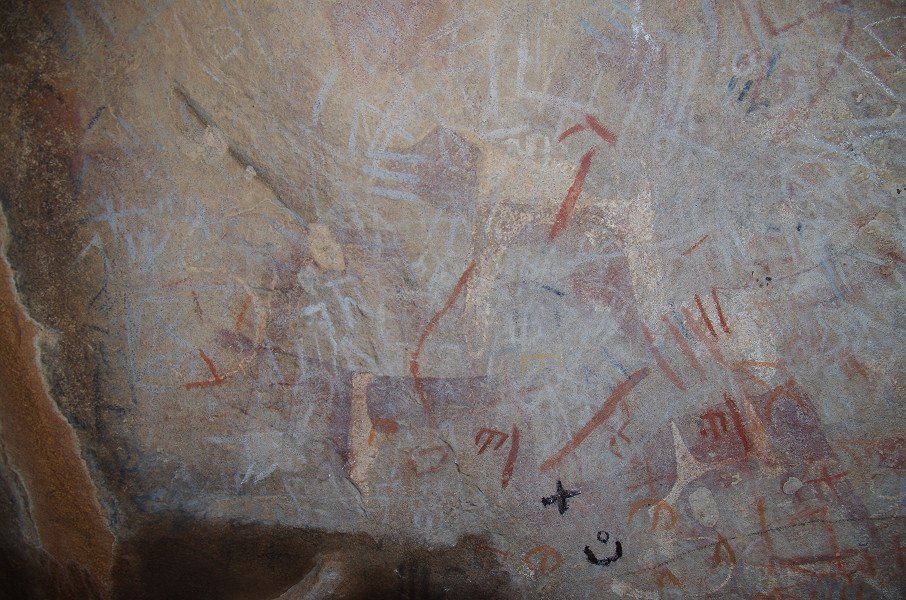
The British Museum offers a broad timeline for the region. The oldest images, of humpless cattle, sheep, goats and wild animals, date from about the mid-3rd to the 2nd millennium BC. Camels appear in the late 1st millennium BC, and humped zebu cattle around the start of the common era. Later, human figures armed with lances, bows and shields appear alongside the cattle.
The ages of individual sites are still debated:
- Dhambalin. It is often described as about 5,000 years old. However, Ali and Ibrahim argue the sheep sit in a later white layer over older red paintings. They note that fat-tailed sheep were domesticated in central Arabia no earlier than 1500 BC.
- Karinhegane. Charcoal from the shelter floor gave dates of about 1,600 to 2,100 years ago. The same authors warn that these dates may not reflect the shelter’s earliest occupation. Wikipedia puts the inscriptions at about 2,500 years old.
- Dhaymoole. Its camels suggest a later date, in line with the museum’s timeline. Wikipedia gives about 3,000 to 5,000 years, so the two do not fully agree.
Why these sites need protection
The Somaliland rock art beyond Laas Geel faces real pressures. At Dhambalin, wind erosion and porous sandstone break off fragments, and sand covers the lower shelter. Across the region, a 2012 study found paintings worn by weathering and rubbing by animals and people, with graffiti in some places. In 2011, AFP reported risks from looting, clandestine excavation and unplanned development.
International listing is not simple either. In 2017, the Christian Science Monitor reported that Somaliland’s status had blocked a World Heritage bid for Laas Geel. Somalia ratified the World Heritage Convention in July 2020. None of the three sites on its tentative list is a Somaliland rock art site.
There is good news as well. Horn Heritage, CyArk and ICCROM have digitally documented Laas Geel, Dhagah Kureh and Dhagah Nabi Galay and trained local professionals. Mire, now at UCL’s Institute of Archaeology, said in 2010: “These are among the best prehistoric paintings in the world.”
Seeing Somaliland rock art for yourself
Laas Geel is the best-known site, with a caretaker and a sign asking visitors not to touch the art. It is the natural place to start. We could not find published visitor arrangements for Dhambalin or the other shelters. If you hope to see one, ask your hotel or a licensed guide well in advance.
- Start with Laas Geel. Our Laas Geel guide covers permits and the drive from Hargeisa.
- Dhambalin and Dhaymoole are in Sahil, the region around Berbera.
- Transport. Arrange a driver through your hotel. Read Getting Around Somaliland first.
- Respect the paint. Do not touch the panels, and switch off your flash. At Laas Geel, touching and flash photography have been reported as risks to the paintings.
- Before you go: Sahil is one of the western regions where most visitors travel. Karinhegane lies far to the east in Sanaag, where current UK travel advice is more cautious. Have a look at the latest advice and read Is Somaliland Safe?
Somaliland rock art is still being discovered, one shelter at a time. Begin with the famous panels of Laas Geel. Then keep an eye on the research still coming from the shelters further afield.
Sources
- The Discovery of Dhambalin Rock Art Site, Somaliland, Sada Mire, African Archaeological Review 25(3–4), 2008, pp. 153–168, doi:10.1007/s10437-008-9032-2 (abstract on the author’s site, accessed 28 October 2026).
- Rock Art in Somaliland: Discovery of Two New Rock Painting Sites, M. Y. Ali and I. Ibrahim, Adumatu no. 25, January 2012, pp. 7–24.
- Laas Geel rock art, object 2013,2034.15855 and Dhaymoole rock art, object 2013,2034.15386, British Museum, African rock art image project (accessed 28 October 2026).
- Rock Art Sites of Somaliland (in depth), CyArk (accessed 28 October 2026).
- Somaliland Rock Art: Laas Geel, Dhagah Kureh and Dhagah Nabi Gelay, Sada Mire, Leiden University, 9 September 2013.
- Archaeologists find cave paintings at new African sites, Mail & Guardian (from The Guardian), 18 September 2010.
- Grotto galleries show early Somali life, AFP via Dawn, 26 April 2011.
- Sada Mire interviewed by CNN: ‘First-aid’ needed for 5,000-year-old Somali cave paintings, CNN interview excerpt, February 2011 (accessed 28 October 2026).
- Finding Somaliland’s ancient cave art is hard. Protecting it could be harder., Scott Peterson, The Christian Science Monitor, 16 August 2017.
- Somalia – States Parties, UNESCO World Heritage Centre (accessed 28 October 2026).
- Dhambalin, Wikipedia (accessed 28 October 2026).
- Karinhegane, Wikipedia (accessed 28 October 2026).
- Caves in Somaliland, Wikipedia (accessed 28 October 2026).
- List of World Heritage Sites in Somalia, Wikipedia (accessed 28 October 2026).
- Sada Mire, Wikipedia (accessed 28 October 2026).
- Somalia travel advice: regional risks, UK Foreign, Commonwealth & Development Office (updated 4 June 2026, accessed 28 October 2026).
Last checked 28 October 2026. Found an error or something out of date? Tell us.