Visiting Laas Geel
Laas Geel, a cluster of rock shelters outside Hargeisa, holds some of the earliest known and best-preserved rock art in the region. What you will see, how to get there, and how to visit responsibly.
PLACES · HERITAGE
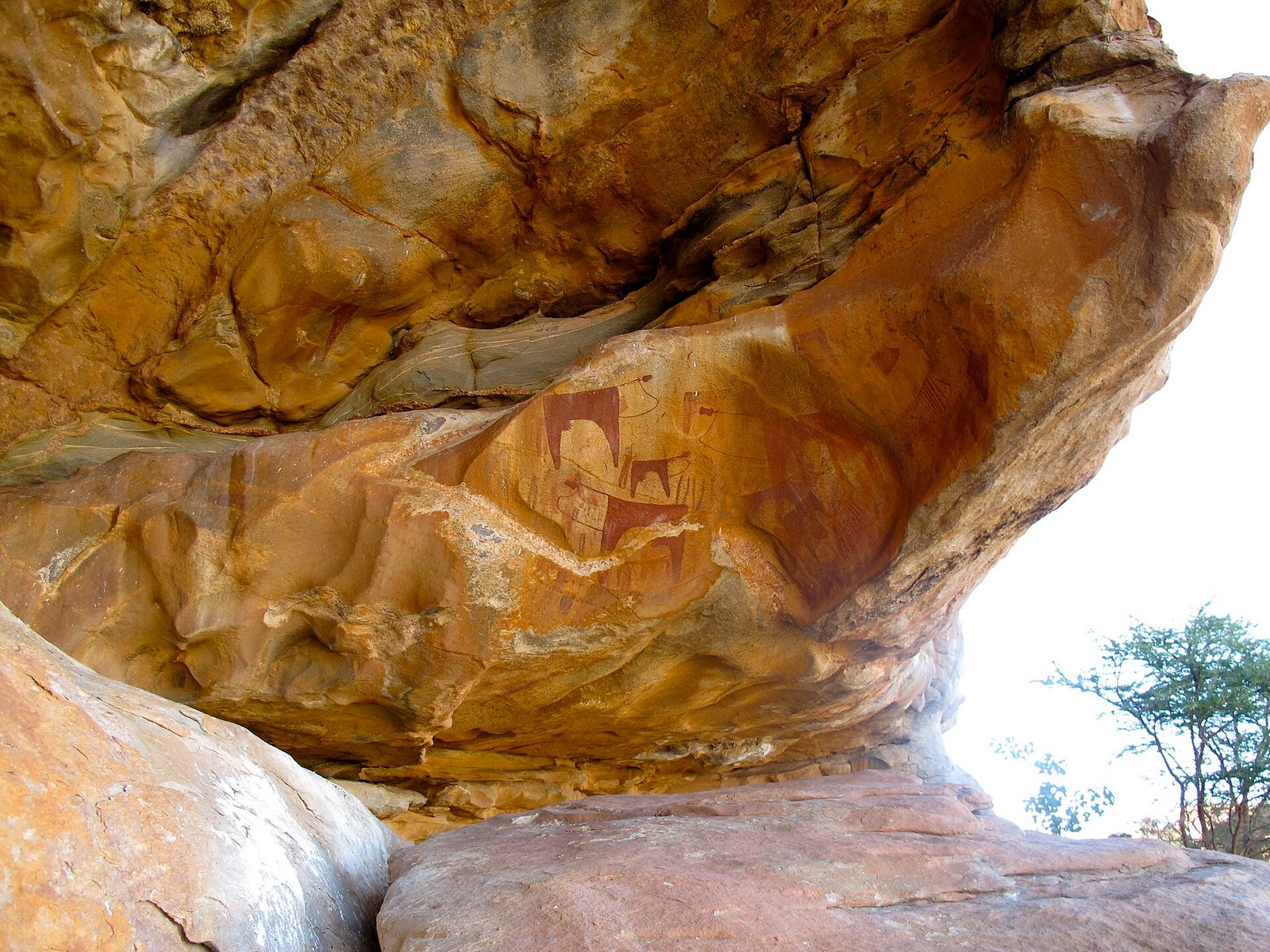
The road east of Hargeisa runs through scrub and granite, and then, quite suddenly, the boulders open into shelters whose ceilings are covered in paint. Long-horned cattle, people standing among them, a dog, a giraffe. They have been here for thousands of years, and for most of that time the outside world did not know they existed.
What the name Laas Geel means
In Somali, laas means a well and geel means camel. The name refers to a water source where camels and other livestock still come to drink, a reminder that this has been herding country for a very long time.
What you will see at Laas Geel
The site has around twenty rock shelters, many of them painted; sources differ on the exact count. Its best-known images show cattle, cows and bulls, painted in what appear to be ceremonial robes, with decorated necks, accompanied by human figures. Researchers believe the painters were herders. Elsewhere on the walls are a domesticated dog, other canids, a giraffe and a camel. The style is shared with other rock art sites in Somaliland, including Dhambalin and Karinhegane.
The paintings are estimated to be around 4,500 to 5,500 years old. They survive in remarkable condition because overhanging granite has sheltered them from sun and rain.
How to read the Laas Geel paintings
It helps to know what to look for. According to the British Museum’s African rock art project, most of the paintings show humpless cows with curved or lyre-like horns and prominent udders. Their necks are drawn abnormally wide and decorated with red and white stripes; the museum calls the paintings “enormously colourful”. The human figures are simpler. The French Ministry of Culture describes them as schematic, clothed people with wide-open arms. Look closely, too, for a later chapter: in time, painted animals gave way to engraved herds of dromedaries.
Beyond that, the setting matters as much as the art. The shelters sit around a granite outcrop at the meeting point of two wadis, or seasonal rivers. And Laas Geel is not alone: most known rock art sites in Somaliland lie in the region between Hargeisa and Berbera. If the road takes you on to the coast, read Berbera: Where the Desert Meets the Sea.
“Local people knew about these paintings for centuries. The rest of the world found out in 2002.”
A discovery that was not a discovery
In November and December 2002, a French archaeological team surveying the region for rock shelters came upon the paintings, and a team returned in November 2003 for detailed study. International attention followed. But the people who lived nearby had known about the paintings for centuries. What changed in 2002 was not that they were found, but who was told.
Protecting the site
Protecting the site has been a shared effort. In 2020 the European Union funded its first international support for the site, run by the Hargeysa Cultural Centre with Somaliland’s tourism ministry: fencing, the removal of invasive vegetation and new visitor pathways. In 2021 the Factum Foundation, working with the Hargeysa Cultural Centre, made high-resolution 3D recordings of seven of the caves and trained local staff in the technique.
Even so, visitor numbers are still modest. In 2016, AFP reported around a thousand visitors a year; two years later, Gulf News put the figure at about 100 a month. More feet bring new risks. The same AFP report noted that trampling on the bare, gravelly soil raises dust that may contribute to the fading of the paintings. That same year, UNESCO sent a technical expert mission, from 28 October to 2 November 2016, to assess the site’s condition and recommend conservation steps. Staying on the paths is one simple way every visitor can help.
How to visit Laas Geel
Laas Geel lies about 40 to 50 kilometres from Hargeisa. Visitors have typically needed a permit and an armed escort, usually arranged through a hotel or a licensed guide. Requirements and fees change, so confirm them locally before you set out, and read our guide to entry and visas and Is Somaliland Safe? first. To pick your season, see the best time to visit Somaliland.
At the site, follow your guide’s instructions. Never touch the paintings, even lightly: the oils on human skin can damage pigment that has survived for millennia. Ask before using a flash. And take your time. Most of what matters here is in the details.
Laas Geel is an easy pairing with a few days in the capital. Start with our Hargeisa Travel Guide, and for the bigger story of how this region connected to the ancient world, read The Ancient Treasure That Linked Somaliland to Rome. And for Somaliland’s living wildlife, read Saving Somaliland’s Cheetahs.
Sources
- Laas Geel: the African Lascaux, French Ministry of Culture, Archaeology.
- The EU and the Hargeysa Cultural Center join hands to protect the Laasgeel cave paintings, EU Delegation to Somalia, 8 March 2020.
- The painted chambers of Laas Geel, Factum Foundation, 2021.
- Laas Geel, Wikipedia.
- Laas Geel rock art image, curator’s comments, British Museum (African rock art image project).
- Rocky future for Somalia’s ancient cave art, AFP via The Peninsula, 27 June 2016.
- Laas Geel heritage: world’s best-kept secret, Gulf News, 5 November 2018.
- UNESCO expert mission examines the state of conservation of Laas Geel Rock Art site in Somaliland, Horn Diplomat, 6 November 2016.
Last checked 28 October 2026. Found an error or something out of date? Tell us.