Somali Poetry: When Words Were Mightier Than Weapons
In Somaliland, Somali poetry has halted clan fighting, defied a dictator and set the terms of national debates. A short history of the region’s most powerful art form.
CULTURE · LONG READ
Imagine a country where a poem can send its author to prison, rally an opposition movement, or persuade two armed groups to walk away from a fight. In Somaliland, none of this is hypothetical. For generations, verse has been the medium in which the region argues with itself, and the people who compose it have carried the weight of politicians, judges and journalists.
Somali poetry: a nation of poets
The Canadian novelist Margaret Laurence called the Somalis a “nation of poets”, and the phrase stuck. Somali had no official written form until 1972, when a modified Latin script was adopted. Before that, and long after, poems lived in memory: composed aloud, learned by heart and carried from one gathering to the next.
The craft is demanding. Somali poetry follows strict alliteration, with the same sound recurring throughout a poem, so a listener can hear at once whether a verse is well made. There are distinct forms for distinct purposes: the weighty, chanted gabay; the short geeraar, traditionally associated with war; and the buraanbur, composed by women.
The poem that stopped a war
Early in the twentieth century, two related kin groups were on the brink of fighting. A religious leader tried to mediate and failed. Then the poet Salaan Carrabey recited a poem known as “Oh Clansmen, Stop the War”. The forces disengaged. In the retelling of the scholar Maxamed Daahir Afrax, the poem achieved what the sheikh’s appeal had not.
It is the clearest illustration of a principle that runs through Somali society: a well-made argument in verse can carry more authority than a written agreement. For the unwritten rules that sit alongside it, read The Unwritten Laws That Guided Generations.
“In Somaliland, a poem can still set the terms of a national debate.”
Verses against a dictator
Under the military government of Siad Barre, poetry became one of the few spaces where dissent could be voiced, and the regime knew it. In the early 1970s, the poet Mohamed Ibrahim Warsame, known as Hadraawi, contributed to a poetic debate whose imagery was read as a call for freedom. He was imprisoned from 1973 to 1978, and reportedly refused an offer of release in exchange for a written apology.
In 1979, his friend Maxamed Xaashi Dhamac, known as Gaarriye, published a poem against tribalism that opened a new chain of poems, the Deelley. The government had commissioned the debate, hoping to weaken clan loyalties. Instead, nearly 70 poems filled the chain within six months, the verses turned against the regime, and the government withdrew its endorsement. The historian Abdirahman Yusuf Ducaale, who tracked down the poets for his book on the debate, records that it went on long after the government tried to declare it over.
Somali poetry for peace
When the war ended, words were part of the repair. Oratory and poetry, used by both men and women, helped end hostilities in Somaliland through a series of peace meetings in the early 1990s. In 2003, Hadraawi travelled the country promoting peace and non-violence, welcomed in many places as something close to a spiritual leader. He died in 2022, and is still widely regarded as the greatest Somali poet of his era. To see how Hadraawi is remembered in Hargeisa today, read Inside the Somaliland National Museum.
Somali poetry today: a living tradition
The form is far from a museum piece. In 2017, after parliament approved a foreign military base at Berbera with little public debate, the poet Weedhsame answered with a poem that started a new chain, the Miimley. More than 90 poets contributed some 120 poems, and the issues they raised were part of the conversation in the presidential election that followed.
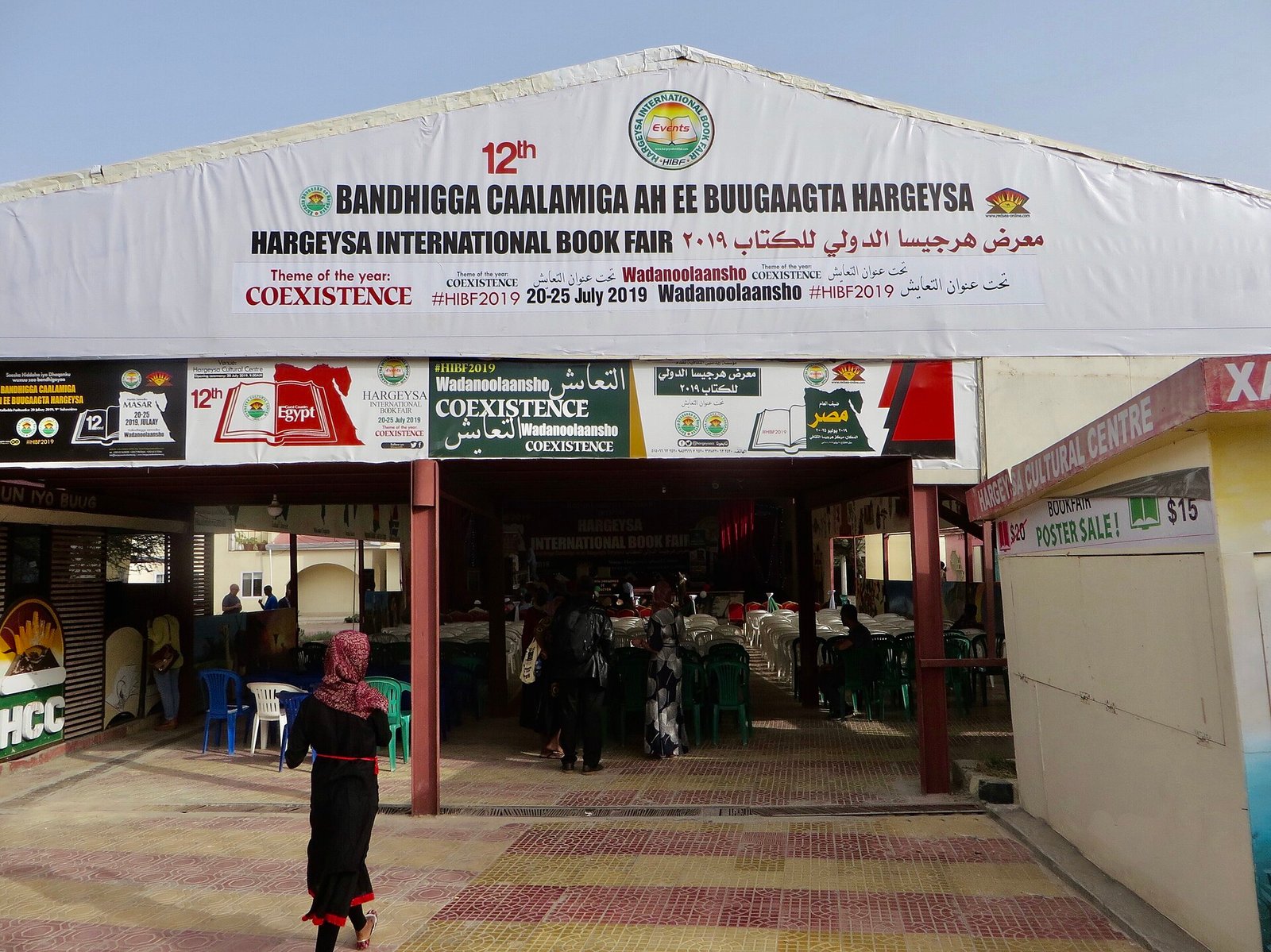
For visitors, the best place to feel this tradition is the Hargeisa International Book Fair, held most years in July. Our Hargeisa Travel Guide explains how to plan a trip around it. For English translations of Hadraawi, Gaarriye and others, the Poetry Translation Centre in London is an excellent place to begin.
Sources
- Towards a culture of peace: poetry, drama and music in Somali society, Maxamed Daahir Afrax, Accord 21, Conciliation Resources, 2010.
- A Country Shaped By Poetry, Nina Strochlic, Noema Magazine, 21 February 2024.
- Hadraawi: the eternal voice of Somali poetry, Ebuzer Demirci, Geeska, 23 August 2024.
- African literature: Somali, Encyclopaedia Britannica.
- Somali literature, Wikipedia.
Last checked 24 October 2026. Found an error or something out of date? Tell us.