The Somaliland Flag: Meaning, History and National Symbols
The Somaliland flag is green, white and red, with a black star and a line of Arabic script. Here is what it shows, where it came from, and the falcon emblem and anthem that go with it.
HISTORY · NATIONAL SYMBOLS
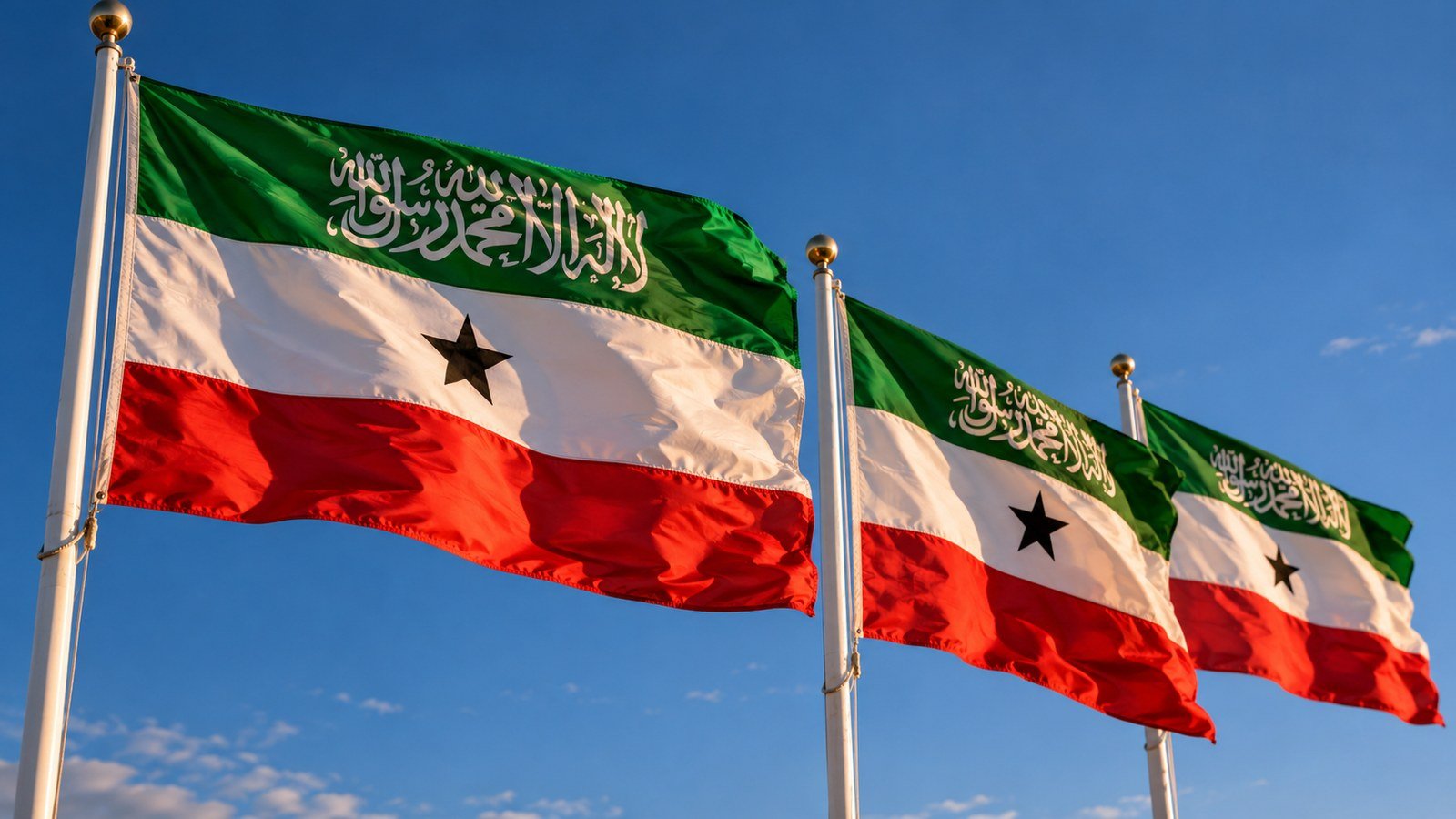
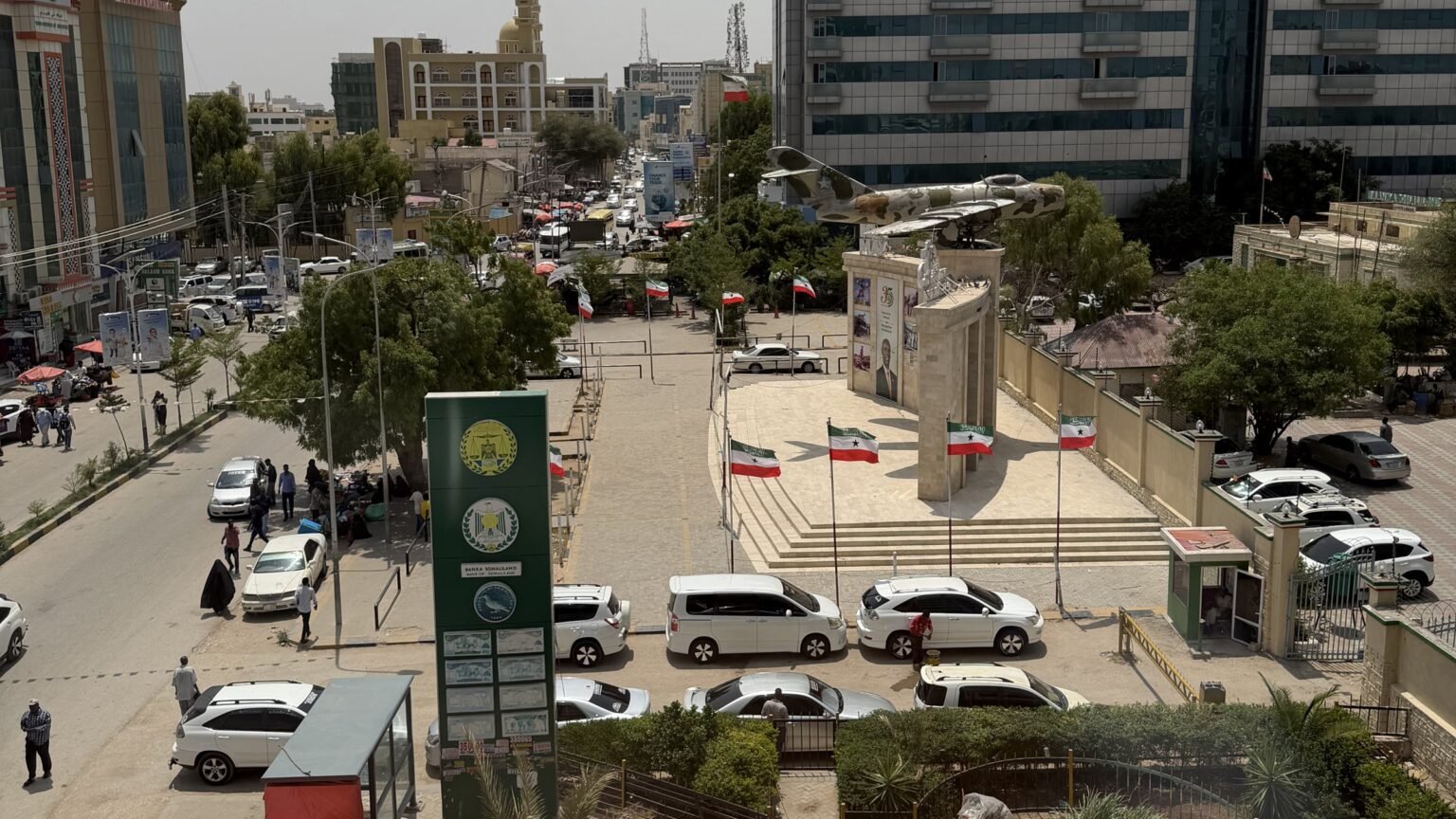
In central Hargeisa, flags fly on tall poles around the square of the city’s war memorial. They are green, white and red, with a black star in the middle. Yet the design is only thirty years old, and it replaced a very different flag. Here is the story of the Somaliland flag, and of the emblem and anthem that go with it.
Somaliland declared independence from Somalia in 1991 and governs itself. Somalia regards it as part of its territory. Israel (December 2025) is so far the only UN member state to recognise it.
The Somaliland flag at a glance
Here are the basic facts in one place.
| Fact | Detail |
|---|---|
| Adopted | 14 October 1996 |
| Layout | Three horizontal, equal stripes: green, white and red |
| Top stripe | The Shahada in white Arabic script |
| Middle stripe | A black five-pointed star |
| Legal basis | Article 7 of the constitution |
| Changing it | Needs a resolution of the House of Representatives |
What the Somaliland flag shows
Article 7 of Somaliland’s constitution sets out the design. The flag has three horizontal, parallel and equal sections. The top section is green, with an Arabic inscription in white. That inscription is the Shahada, the Islamic declaration of faith. It fits the wider constitution, which names Islam as the religion of the state.
The middle section is white, with a black five-pointed star at its centre. The bottom section is red.
What do the colours mean? The constitution does not say. It describes the design but gives no official meaning for the colours or the star. So any meaning you read elsewhere is an interpretation, not the law.
From a blue flag to green, white and red
The story starts in 1960. On 26 June that year, British Somaliland became independent as the State of Somaliland. For its few days as a separate country, it flew a light blue flag with a white five-pointed star. This was the same design as Somalia’s.
That flag was designed by the Somali scholar Mohammed Awale Liban and approved on 12 October 1954. Its star has five points for the five areas where Somalis form the main population: Djibouti, Somaliland, the Somali region of Ethiopia, north-eastern Kenya and Somalia.
On 1 July 1960, the State of Somaliland united with the south to form the Somali Republic, and the blue flag stayed. After the union broke down, Somaliland declared the restoration of its independence on 18 May 1991. That date is now Somaliland’s Independence Day.
The current Somaliland flag came five years later. A national conference adopted it, together with the national emblem, on 14 October 1996. Its place in law was then sealed by the constitution, approved by referendum on 31 May 2001.
The falcon emblem
The national emblem was adopted on the same day as the flag. It was introduced by Abdullahi Abdi Omar (Jawaan).
The constitution describes it in detail. At its heart is a coffee-coloured falcon with the words ALLAHU AKBAR on its breast. Below the bird are two shaking hands, and a pair of scales hangs above them. Two strands of green leaves surround the figures, and the Bismillah is written at the top.
Descriptions of the bird differ. The constitution calls it a falcon, while Wikipedia’s article also calls it the eagle of Saladin. The same article explains the other symbols: the scales stand for justice, the hands for equality and freedom, and the branch for peace.
Samo ku waar: the national anthem
Somaliland’s anthem is Samo ku waar, which translates as Live in Eternal Peace. It was adopted in 1997. Its words and music are both by Hassan Sheikh Mumin, a well-known Somali playwright and composer.
Mumin was born in 1931 in Zeila, the ancient port on the Gulf of Aden, and died in Oslo in 2008. His best-known work is the play Shabeelnaagood (1965), translated into English in 1974 as Leopard Among the Women. In a country where poetry carries real weight, it is fitting that a playwright wrote the anthem. Read more in When Words Were Mightier Than Weapons.
The constitution also sets a rule for the music. The anthem must have its own music, distinct from that of other countries.
There is an older tune, too. The State of Somaliland had an anthem without words in 1960, transcribed by a British bandmaster. Since 2012, arrangements of it have served as the news theme on SLNTV, the state broadcaster.
Somaliland flag vs Somalia flag
The two flags share a five-pointed star, but little else. Here is how they compare.
| Somaliland | Somalia | |
|---|---|---|
| Colours | Green, white and red | Light blue and white |
| Star | Black, on the white stripe | White, on the blue field |
| Script | The Shahada on the green stripe | None |
| Adopted | 1996 | 1954 |
For the wider picture, from currencies to visas, read Somaliland vs Somalia: What’s the Difference?
Where you will see the Somaliland flag
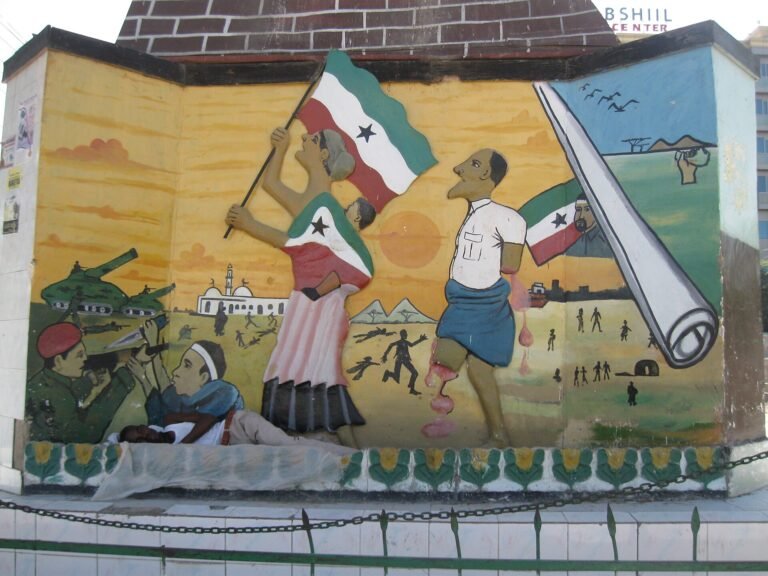
Around the war memorial. The flags on poles around the memorial square in central Hargeisa are the easiest to find.
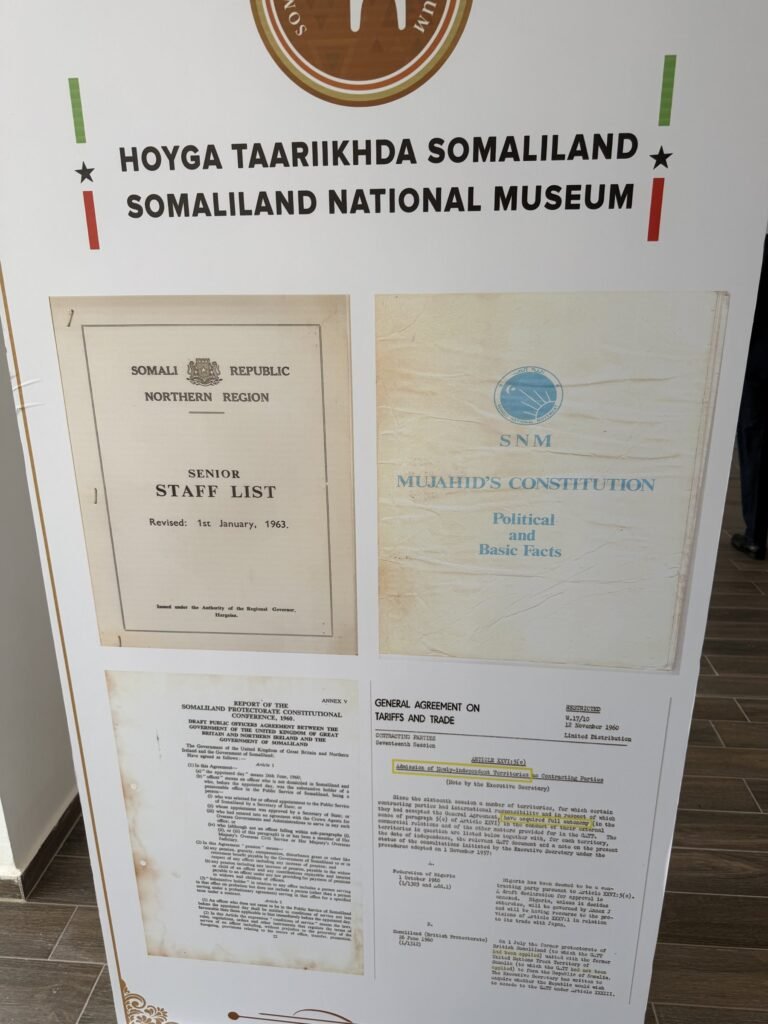
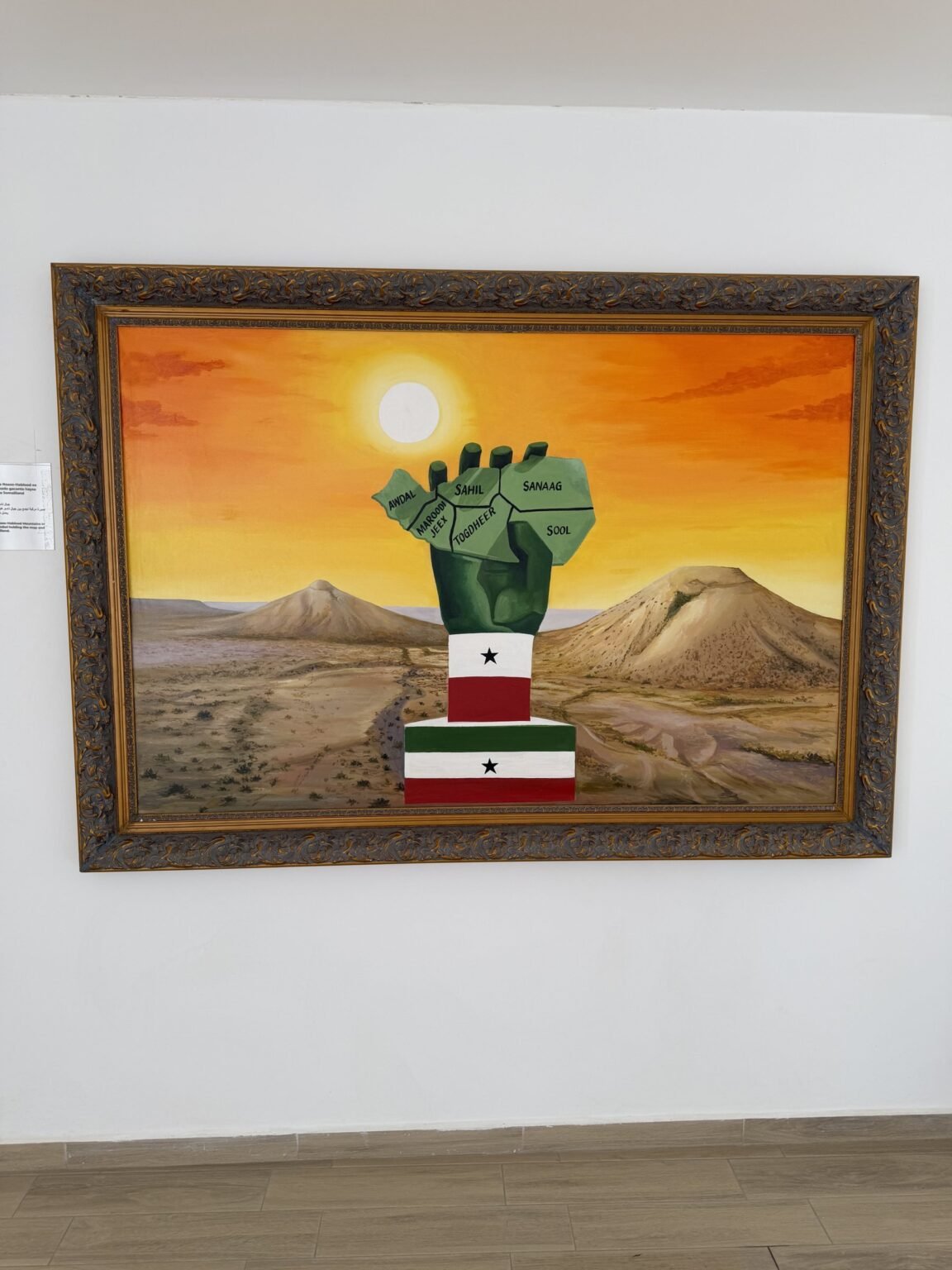
At the National Museum. One of the large paintings shows a raised fist above the green, white and red. We saw it on our first look at the Somaliland National Museum.
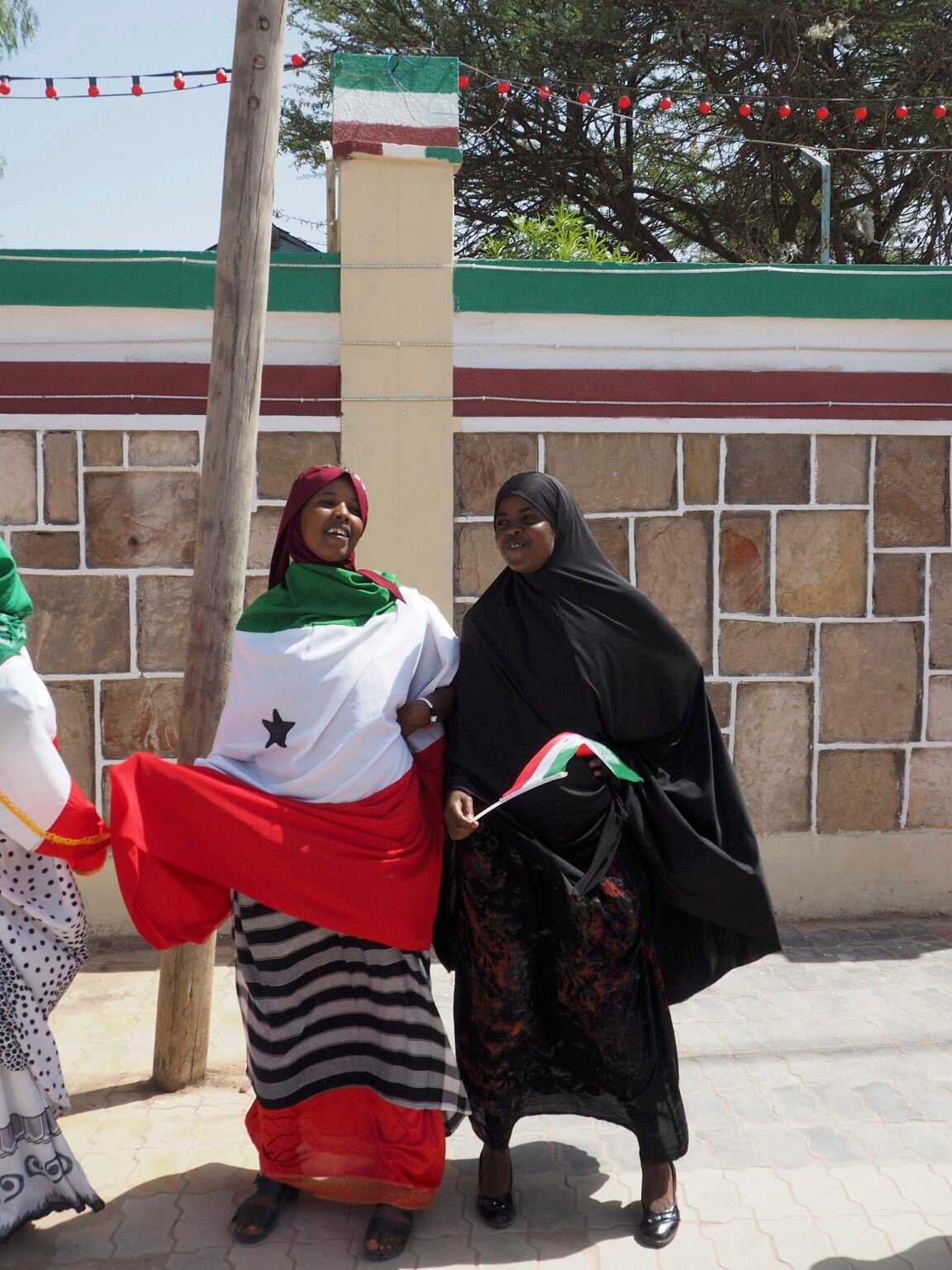
At big moments. When Israel announced its recognition on 26 December 2025, residents in Hargeisa waved Somaliland flags, AFP reported. At a ceremony broadcast live, the Somaliland flag was raised beside Israel’s. Two days later, thousands filled a stadium, many wearing the flag’s green, white and red. Others saw the recognition very differently. Somalia’s president called the decision an aggression against Somalia’s sovereignty. The African Union, Egypt and Turkey were among those who criticised it.
A small tip. Always ask before photographing people, and ask first before photographing soldiers or officials.
The Somaliland flag is at its most visible on national days, when the whole city joins in. To plan a visit around the biggest of them, read 18 May: Somaliland’s Independence Day Explained.
Sources
- Chapter One (Constitution of the Republic of Somaliland, Articles 1–7), Government of Somaliland (accessed 28 October 2026).
- Flag of Somaliland, Wikipedia (accessed 28 October 2026).
- National emblem of Somaliland, Wikipedia (accessed 28 October 2026), citing the Constitution of Somaliland and The New York Times (5 June 2006).
- Flag of Somalia, Wikipedia (accessed 28 October 2026).
- Samo ku waar, Wikipedia (accessed 28 October 2026).
- Hassan Sheikh Mumin, Wikipedia (accessed 28 October 2026).
- National anthem of Somaliland (1960), Wikipedia (accessed 28 October 2026).
- Somaliland recognition prompts celebrations, condemnation, AFP (Mustafa Haji Abdinur, with Joris Fioriti) via RNZ, 29 December 2025.
Last checked 28 October 2026. Found an error or something out of date? Tell us.