Camels in Somaliland: Milk, Poetry and the Wealth of the Herd
Camels in Somaliland are far more than livestock. They feed families, fill poems and once set the price of peace. Here is how the camel shapes daily life and culture, from the milk jug to the market.
CULTURE · PASTORAL LIFE
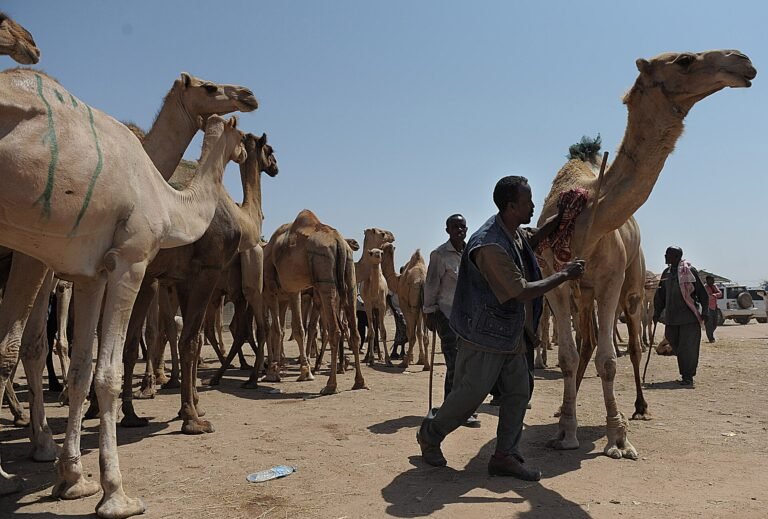
“Here, the camel is king.” That is how Khosar Abdi Hussein, who oversees the livestock market in Hargeisa, summed it up to AFP in 2021. When it comes to camels in Somaliland, he was not exaggerating. Across the Somali world, camels provide milk and meat, carry loads, act as insurance in a crisis and mark a family’s status. The camel even gave its name to a famous place. Laas Geel, the rock art site near Hargeisa, means camel well: laas is a well and geel means camel.
Camels in Somaliland at a glance
Here are the key facts in one place.
| Somali word | Geel (camel), as in Laas Geel |
| Main uses | Milk, meat and hides, plus carrying loads and insurance against hard times |
| In drought | Camels still give milk |
| In customary law | A man’s life was traditionally valued at 100 camels (a woman’s at 50) |
| In the language | Hundreds of Somali terms relate to the camel |
Why camels in Somaliland matter to pastoral life
Somaliland is herding country. Its official statistics note that its rangelands support livestock, particularly camels, goats and sheep. Families move with their herds in search of pasture and water. Camels suit that life well, as they still produce milk during drought.
For generations, camels were the economic mainstay of Somali nomads, giving milk, meat and hides. A 1998 study of Somali tradition by the ICRC and the Somali Red Crescent Society goes further. Camels, it says, were the standard of measurement for all wealth. A man with few camels, the same study notes, had little social or political standing.
Who looks after the herd? A study of herders in central Somalia found that camels are normally herded by unmarried young men and teenagers. Women look after the sheep and goats. The same study describes camels as a source of pride and prestige, and a reserve that families sell only rarely.
That pride runs in families. “I am a camel-keeper and my father and grandfather before me kept livestock,” a herder in Hargeisa told Radio Ergo in 2023. In dry years, herders go to great lengths to keep their animals alive. When the rains failed that year, some fed their camels cactus collected from the hills around Hargeisa, burning off the spines first.
Camels in Somaliland also matter to the wider economy. Official figures call livestock a backbone of the economy; for the bigger picture, read our guide to the Somaliland economy.
Camel milk: the most valued food
For herding families, much of it starts with milk. A study of camel herders in central Somalia called camel milk the most valuable food. Camels are normally milked twice a day, in the morning and the evening, and milk is offered to guests as a sign of hospitality.
In Somaliland, the attachment is just as strong. A study of 384 camel milk producers in Burao found that 90.1 per cent considered camel milk an important part of their diet. Its authors describe camel milk as part of nutrition, livelihoods and identity in Somaliland.
How camel milk is kept
Herders have old ways of keeping milk fresh. In the Burao study, about a third of producers (34.9 per cent) smoked their milk containers, a traditional method of preservation. The rest (65.1 per cent) refrigerated it. Across the border, in Ethiopia’s Somali Region, families make a soured camel milk called dhanaan. A 2025 study found that the containers are smoked for 20 to 30 minutes. The milk then ferments for about 48 to 72 hours. It is eaten mostly in the dry season, when fresh milk is scarce.
In towns, camel milk is now a business too. Research in the Woqooyi Galbeed region in 2021 found camel milk kiosks selling out of product on a near daily basis. Women run much of this trade. The same research traces it to women looking for a way to earn an income during hard times. In Hargeisa, milk from the countryside is sold by women traders across the city’s neighbourhoods, though drought can cut the supply.
Camels in poetry and proverbs
In a culture built on the spoken word, it is no surprise that the camel is celebrated in songs and folklore. The ICRC study notes that camels feature heavily in Somali poetry and song. The verses praise their endurance and value, and recall old raids and disputes.
A modern example comes from Somaliland. Hadraawi, the poet born in 1943 in the Togdheer region, wrote Hal la qalay, which its translators date to 1973. Its title is translated as The Killing of the She-Camel. The poem began as a song in a play and became more popular than the play itself. It angered the military government of the day and, the translators say, it led to Hadraawi’s five-year imprisonment in Qansax Dheere. Its metaphors, the translators note, are open to many interpretations. Read more about the poets in When Words Were Mightier Than Weapons.
Somali speech is full of camels too. The linguist Giorgio Banti has written about hundreds of Somali terms related to the camel. One old saying, recorded by the ICRC, sums up the camel’s unique value: camels could only be assessed in terms of camels.
Counted in camels: xeer, compensation and marriage
The camel was also the currency of justice. Under xeer, Somali customary law, a group pays compensation when one of its members causes harm. A 2006 study for the Danish Refugee Council and Novib/Oxfam explains the scale. In a case of homicide, this payment, called mag or diya, is generally valued at 100 camels for a man and 50 for a woman. In practice it is most often paid in the equivalent amount of money. As the study puts it, mag today is valued in terms of camels, but paid in cash.
Camels once sealed marriages as well. The ICRC study describes them as the only acceptable medium for paying blood compensation and bridewealth in the past. Across the Somali region, camels are still exchanged in marriages or to settle feuds, AFP reported in 2021.
Where to see camels in Somaliland
The easiest place for a visitor is the livestock market in Hargeisa. You can read how to visit it in our guide to things to do in Hargeisa.
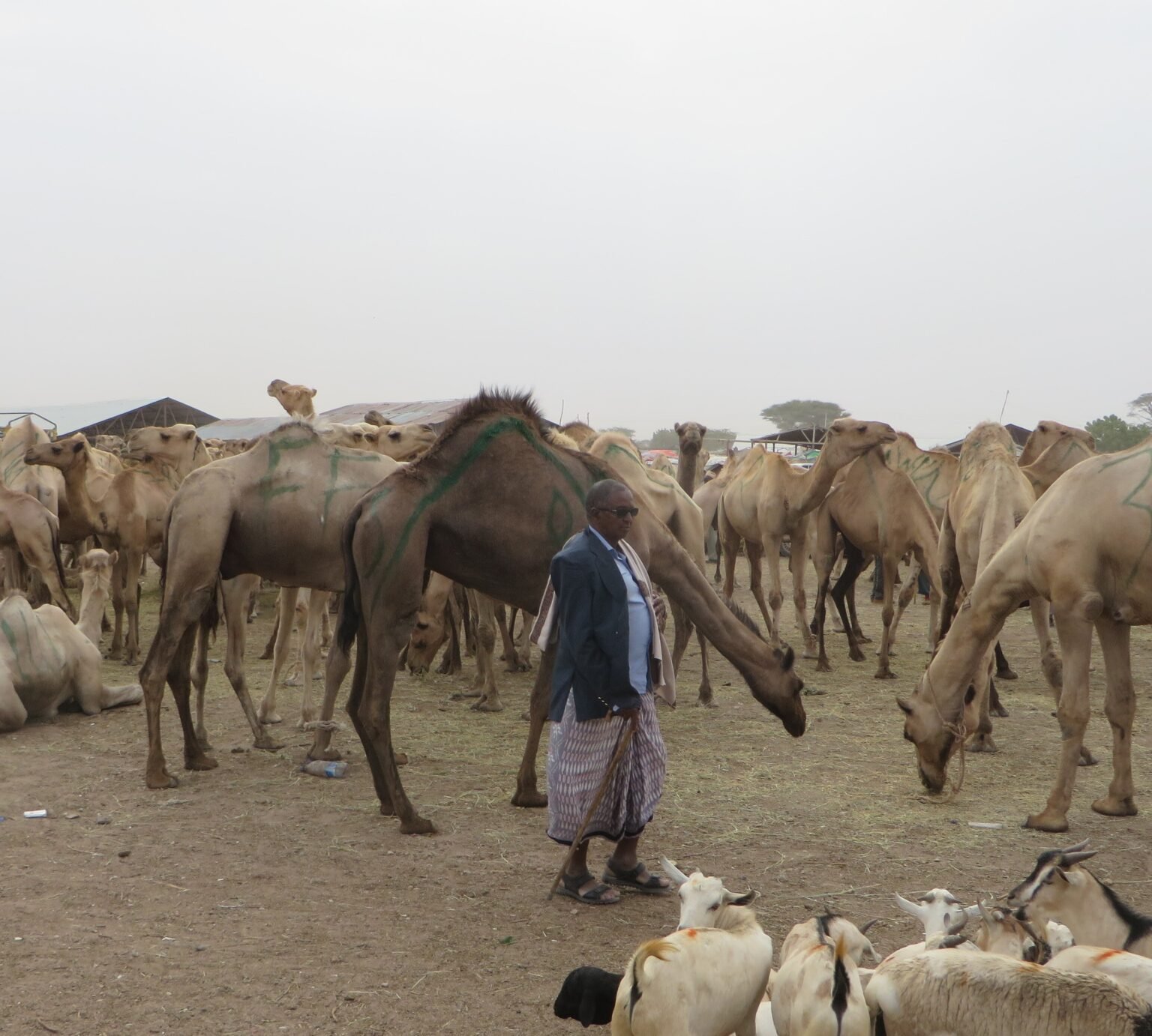
Further east, Burao is home to one of the largest animal markets in the Somali territories, Radio Ergo reported in 2016. Burao’s markets draw livestock from across the Horn of Africa.
Planning your visit
- Ask before photographing people at the market.
- Burao is in the Togdheer region, where current UK travel advice is more cautious than for Hargeisa. Have a look at it before planning a trip beyond Sheikh, and read Is Somaliland safe?
- If you are offered camel milk, accept it in the spirit it is given. If your stomach is not used to it, start with a small glass.
From the milk offered to a guest to the camels given at a wedding, camels in Somaliland carry the story of a pastoral people. To see how those traditions come together on a family’s biggest day, read Inside a Traditional Somaliland Wedding.
Sources
- Milk, meat and might: in Somalia, ‘the camel is king’, Africanews with AFP, 17 November 2021 (updated 13 August 2024).
- Laas Geel, Wikipedia (accessed 28 October 2026).
- Spared from the Spear: Traditional Somali Behaviour in Warfare, ICRC Somalia Delegation and Somali Red Crescent Society, February 1998 (preface by I. M. Lewis).
- The predicament of the ‘Oday’: The role of traditional structures in security, rights, law and development in Somalia, Joakim Gundel, Danish Refugee Council and Novib/Oxfam, November 2006.
- Notes on Somali Camel Terminology, Giorgio Banti, in “Mehr als nur Worte …” (Rüdiger Köppe, 2000), record in the Roma Tre University repository.
- Somaliland in Figures 2025, Central Statistics Department, Ministry of Planning and National Development, 2025.
- Camel Husbandry and Management by Ceeldheer Pastoralists in Central Somalia, Ahmed A. Elmi, ODI Pastoral Development Network, March 1989.
- Cactus and khat keep camels alive in Somaliland, Radio Ergo, 23 January 2023.
- Somaliland pastoralists stranded on a dry plainland with dying animals and no resources to move, Radio Ergo, 7 August 2026.
- Beyond Tradition: What Camel Milk Handling in Somaliland Taught Us About Food Safety, Dek Kahin Yosef, Springer Nature Research Communities, 26 September 2026, on the paper in Discover Food (doi:10.1007/s44187-025-00595-0).
- Fermentation, Handling and Claimed Therapeutic Effects of Dhanaan: An Ethiopian Fermented Camel Milk, Karssa, Kussaga, Semedo-Lemsaddek and Mugula, Food Science & Nutrition, May 2025.
- Drought shrivels up milk supplies in Hargeisa, affecting Somaliland women traders and pastoralists, Radio Ergo, 7 January 2026.
- Got Camel Milk? Challenges and Opportunities in Somaliland, Agrilinks, on an RTI International analysis of March–April 2021.
- Hadrawi, Wikipedia (accessed 28 October 2026).
- The Killing of the She-Camel: notes, Poetry Translation Centre (translated by Said Jama Hussein and Maxamed Xasan ‘Alto’ with W N Herbert), accessed 28 October 2026.
- Burao livestock market back in business after two-month closure, Radio Ergo, 31 May 2016.
- Burao District, Wikipedia (accessed 28 October 2026), citing the Academy for Peace and Development (2002) and the Somaliland Centre for Peace and Development (1999).
- Somalia travel advice, UK Foreign, Commonwealth & Development Office, updated 4 June 2026 (accessed 28 October 2026).
Last checked 28 October 2026. Found an error or something out of date? Tell us.